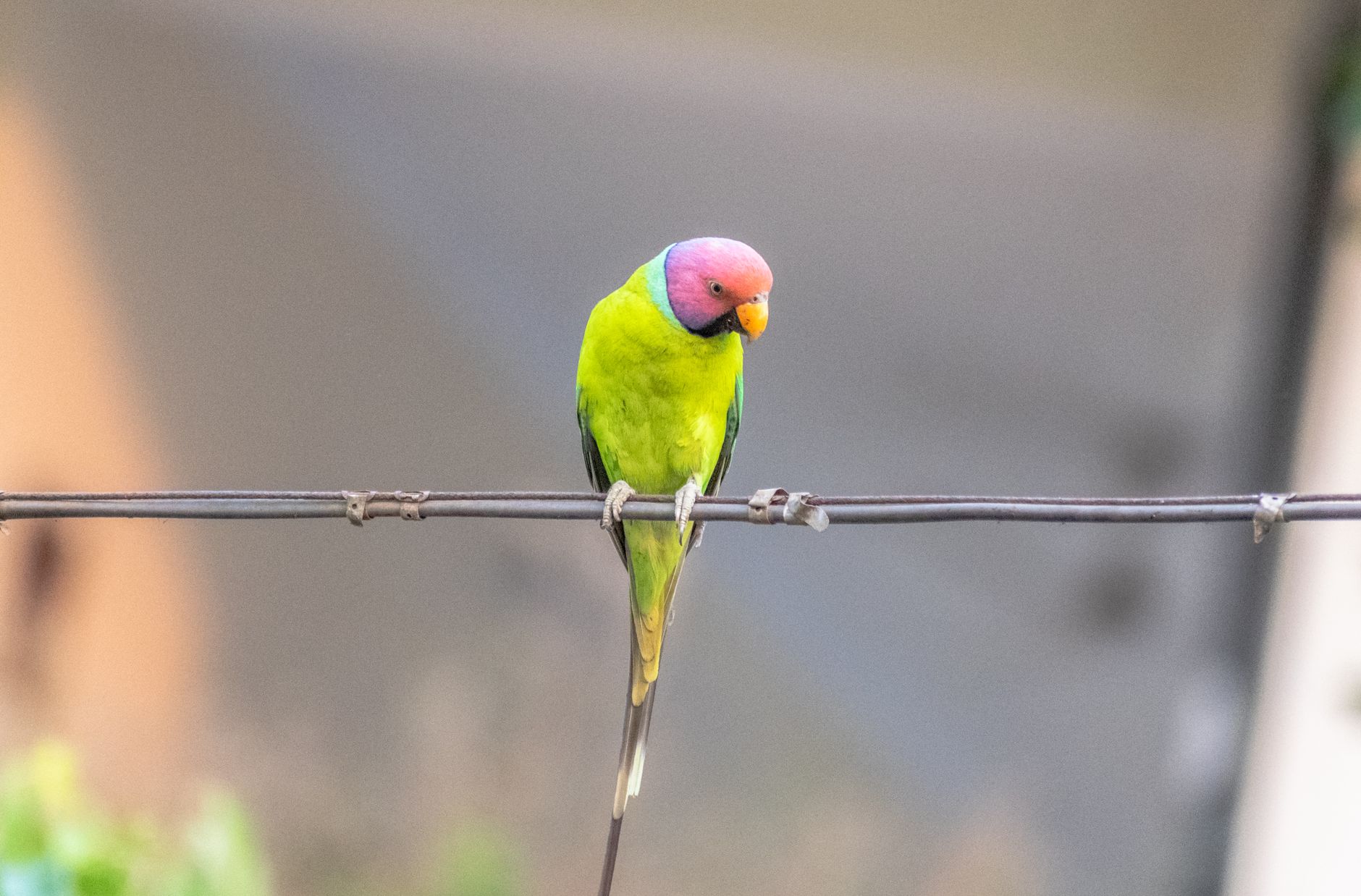
Ever notice how the plum-headed parakeet gets a fraction of the attention that Ring-necked parakeets and budgies soak up, despite being arguably the better-looking bird? I picked up my first plum-head, a wine-capped male named Basil, back in 2018 after watching a breeder’s flight aviary in central Florida for nearly an hour — the color shift on his head from dull red to almost purple depending on the light angle sold me instantly. Adult males carry that deep plum-to-maroon crown and a thin black collar; females wear a soft grey-blue head with no collar at all, which makes this one of the few parrot species where you can sex a bird by eye alone without DNA testing or surgical sexing. At roughly 33 cm nose to tail tip and 50-75 grams, Psittacula cyanocephala is smaller than most people expect from photos, and that tail accounts for nearly half its total length. This guide covers what thesprucepets.com and similar sites gloss over: exact cage dimensions that actually work for that tail, real diet percentages, and what you’ll spend at the vet in year one versus year five.
10 min read
In This Article
- What Is a Plum-Headed Parakeet? Species Overview
- Housing Requirements: Cage Size, Bar Spacing, and Real Setup Numbers
- Diet Specifics: What Plum-Headed Parakeets Actually Need
- Behavioral Traits: Temperament, Noise, and Enrichment
- Health Concerns and Realistic Vet Costs
- Cost Breakdown: What Ownership Actually Costs
- Companion Compatibility: Other Birds, Pets, and Family Life
- Key Takeaways
Key Takeaways
- What Is a Plum-Headed Parakeet? Species Overview
- Housing Requirements: Cage Size, Bar Spacing, and Real Setup Numbers
- Diet Specifics: What Plum-Headed Parakeets Actually Need
- Behavioral Traits: Temperament, Noise, and Enrichment
What Is a Plum-Headed Parakeet? Species Overview
The plum-headed parakeet (Psittacula cyanocephala) is native to the Indian subcontinent — India, Sri Lanka, Bangladesh, and parts of Nepal and Pakistan — where wild flocks are still classified as Least Concern by the IUCN Red List, largely because they tolerate agricultural land and forest edges equally well. In the wild they’re actually considered a minor crop pest in rice and millet-growing regions, which tells you something about how adaptable their feeding behavior is. Adults reach sexual maturity around 2 to 3 years old, and that’s also roughly when the head coloration fully sets in — young males look almost identical to females until their second or third molt.
Lifespan is where I think a lot of buyers get blindsided. Most aviculture references, including the Association of Avian Veterinarians’ general psittacine lifespan data, put plum-heads at 15 to 20 years in captivity, with some well-documented individuals reaching into their mid-20s under excellent husbandry. That’s a longer commitment than a Labrador Retriever’s 10-14 year average, and it’s worth sitting with before you buy. Basil is 7 now, and I’ve already had to plan around the fact that he’ll likely outlast my current apartment lease three or four times over.
Color mutations exist and change the price math significantly. Wild-type (normal) plum-heads typically run $250-$400 from a reputable breeder, while blue mutations and lutino (yellow) mutations can climb to $500-$900 depending on region and breeder reputation. Cinnamon and pied variants sit somewhere in between. If a “plum-head” is priced under $150, ask hard questions — that price point usually signals either an unweaned chick being sold too early or a bird with undisclosed health issues.
Cinnamon and pied variants sit somewhere in between.
Housing Requirements: Cage Size, Bar Spacing, and Real Setup Numbers
This is the section where generic bird care articles fail plum-head owners specifically, because they treat this species like a budgie. Don’t. That long tail (up to 18 cm of the bird’s total 33 cm length) gets destroyed against cage bars in undersized enclosures, and I’ve seen frayed, bent tail feathers firsthand in a friend’s bird that was housed in a 24 x 18 x 24 inch cage meant for cockatiels. The minimum I’d recommend is 24 x 24 x 36 inches (W x D x H), and a flight-style cage at 30 x 24 x 48 inches gives noticeably better quality of life — mine uses the Prevue Pet Products Wrought Iron Flight Cage (model F050), which runs 31 x 20.5 x 53 inches and retails around $220-$260 depending on the retailer.
Bar spacing matters more than most first-time owners realize. Plum-heads need bar spacing between 1/2 inch and 5/8 inch (12.7mm-15.9mm) — wider than that and a curious juvenile can wedge its head trying to squeeze through, which is a genuine emergency-vet-visit risk, not a theoretical one. A&E Cage Co’s Co-1002 flight cage line and Kings Cages’ SLF series both spec out at 1/2 inch bar spacing and are commonly stocked by breeders who specialize in Asiatic parakeets for exactly this reason. Avoid anything marketed generically as a “conure cage” without checking the spec sheet, since some of those run 3/4 inch spacing, which is too wide.
Perch diameter should vary between 12mm and 20mm to keep foot muscles engaged — I rotate a natural java wood perch with a Manzanita branch perch (both under $15 on their own) rather than relying solely on the dowel perches that ship with most cages. Budget roughly 3 hours a week for cleaning: daily paper liner changes take 5 minutes, but the full cage breakdown and disinfect — I use a diluted F10SC avian disinfectant, about $18 for a 200ml concentrate that makes several gallons — takes closer to 40 minutes weekly. Skipping that full clean is the single most common mistake I see in plum-head owners; droppings buildup on grates breeds Aspergillus mold spores, and this species’ respiratory system is not forgiving of poor air quality.
Cage Size Comparison by Bird Size
- Budgerigar (17-20 cm): minimum 18 x 18 x 18 in, bar spacing 3/8-1/2 in
- Plum-headed parakeet (33 cm): minimum 24 x 24 x 36 in, bar spacing 1/2-5/8 in
- Indian ring-necked parakeet (40-42 cm): minimum 24 x 24 x 48 in, bar spacing 5/8-3/4 in
- African grey (33-41 cm, heavier build): minimum 24 x 36 x 48 in, bar spacing 3/4-1 in
Diet Specifics: What Plum-Headed Parakeets Actually Need
Wild plum-heads eat seeds, ripening grain, blossoms, wild fruit, and occasional nectar — a diet that’s higher in carbohydrate and lower in fat than most commercial seed mixes assume. In captivity, I’ve had the best results running roughly 50% high-quality pellet, 30% fresh vegetables and fruit, 15% seed mix, and 5% occasional treats and sprouted legumes. That’s noticeably lower on the seed percentage than what’s printed on most bagged “parakeet mix” packaging, which can run 70-90% seed and leads to fatty liver disease over years of overuse.
For pellets, I switched Basil to Harrison’s Bird Foods Adult Lifetime Coarse a few years back after using Zupreem FruitBlend Medium (for birds 3.5-10 inches), and I noticed firmer droppings and less pickiness within about three weeks — Harrison’s is formulated without added sugars or artificial coloring, which matters since plum-heads can be selective eaters that pick out the dyed seed pieces from mixed blends and ignore the rest. Roudybush Daily Maintenance (small bird formula) is another solid option and tends to run slightly cheaper, around $14-$16 for a 4 lb bag versus Harrison’s $18-$22 for a comparable size.
Fresh food rotation should include dark leafy greens (kale, dandelion greens, romaine — never iceberg, it’s nutritionally empty), shredded carrot, steamed sweet potato, and small amounts of apple or papaya with seeds removed. Avoid avocado entirely — it contains persin, which is toxic to psittacines — and skip chocolate, caffeine, and anything containing xylitol. I feed fresh food once daily, removed after 3-4 hours to prevent bacterial growth in the cage, and offer the pellet/seed mix free-choice through the day.
| Diet Component | Recommended % | Example Products |
|---|---|---|
| Pellets | 45-55% | Harrison’s Adult Lifetime, Roudybush Daily Maintenance |
| Fresh vegetables/fruit | 25-35% | Kale, carrot, papaya, steamed sweet potato |
| Seed mix | 10-15% | Kaytee Fiesta Parakeet blend (small portion only) |
| Treats/sprouts | 5% | Sprouted mung bean, millet spray (occasional) |
I feed fresh food once daily, removed after 3-4 hours to prevent bacterial growth in the cage, and offer the pellet/seed mix free-choice through the day.
Behavioral Traits: Temperament, Noise, and Enrichment
Plum-heads sit in an interesting middle ground on the noise spectrum. They’re quieter than Indian ring-necked parakeets, which can produce piercing contact calls that carry through apartment walls, but they’re not silent — expect morning and evening contact calls lasting 5-10 minutes, plus occasional alarm shrieks if startled. On a rough 1-10 noise scale where budgies sit around a 3 and sun conures sit around a 9, I’d put plum-heads at a 5, closer to a cockatiel than to their larger Psittacula cousins.
Temperament-wise, they’re not typically cuddly birds. Basil tolerates head scratches maybe twice a week on his terms and otherwise prefers to observe from a perch a few feet away — this is fairly typical of the species and differs sharply from cuddlier companion species like cockatiels or budgies. They can be nippy during adolescence (roughly 6 months to 2 years), often called “the bluffing stage” by breeders, where hormonal males in particular test boundaries with beak pressure. Consistent, calm handling during this window matters more than any single training technique.
Mental stimulation needs are real but modest compared to larger parrots. I rotate foraging toys weekly — a Planet Pleasures Woven Foraging Ball ($8-12) alongside a Kaytee Nut & Veggie Bird Kabob — and give Basil roughly 2-3 hours of supervised out-of-cage time daily. Without that, plum-heads can develop feather-damaging behavior; I’ve seen it firsthand in a rescue bird that spent most of its first three years in a cage smaller than the 24 x 24 x 36 inch minimum with zero foraging enrichment. It took nearly a year of consistent foraging toy rotation and out-of-cage time before that bird’s feather condition visibly improved.
Health Concerns and Realistic Vet Costs
Plum-headed parakeets are generally hardy compared to some other Psittacula species, but they’re not immune to the usual psittacine risk list. Psittacosis (Chlamydia psittaci) and Aspergillosis are the two respiratory concerns I’d watch closest, given how sensitive this species’ air sacs are to dust and mold. Polyomavirus and Psittacine Beak and Feather Disease (PBFD) screening is worth doing at the first vet visit, especially if the bird came from a breeder with mixed-species aviaries.
Annual wellness exams with an avian-certified vet (look for Board Certification through the American Board of Veterinary Practitioners in avian practice) typically run $50-$90 for the exam alone, with a fecal gram stain and basic bloodwork adding another $80-$150. A full PBFD/Polyomavirus DNA panel through a lab like Avian Biotech runs roughly $45-$65 per bird. I budget $250-$350 a year for routine plum-head care assuming no complications — Basil’s had one minor incident (a cracked beak tip from a fall) that cost $180 for the emergency visit and follow-up trim.
Nail and beak overgrowth is common in cage-bound birds without enough abrasive perch surface, so I keep at least one concrete or cement perch (like the Polly’s Pet Products Cement Perch, around $9-$14) in rotation to naturally wear down growth between vet visits. Watch for tail-bobbing at rest, discharge from nares, or fluffed-up posture lasting more than a day — any of those warrants a same-week vet call, not a wait-and-see approach, since psittacines mask illness well until they’re seriously compromised.
A full PBFD/Polyomavirus DNA panel through a lab like Avian Biotech runs roughly $45-$65 per bird.
Cost Breakdown: What Ownership Actually Costs
Upfront costs surprise a lot of first-time buyers because the bird itself often isn’t the biggest line item. Here’s a realistic first-year breakdown based on what I actually spent setting up for Basil, adjusted for 2024 pricing on comparable products:
| Item | One-Time or Recurring | Estimated Cost |
|---|---|---|
| Bird (normal color mutation) | One-time | $250-$400 |
| Flight cage (Prevue F050 or equivalent) | One-time | $220-$260 |
| Perches, toys, dishes (initial set) | One-time | $60-$100 |
| Pellet food (annual, Harrison’s/Roudybush) | Recurring/year | $130-$170 |
| Fresh produce (annual, estimate) | Recurring/year | $80-$120 |
| Routine vet care | Recurring/year | $250-$350 |
| Toys/enrichment replacement | Recurring/year | $60-$90 |
Add it up and you’re looking at roughly $530-$760 in the first year including the bird and full cage setup, then a steady $520-$730 per year afterward for a healthy bird with no major incidents. Compare that to a budgie’s typical annual upkeep of $200-$350 or an African grey’s $600-$1,000+, and plum-heads land in a genuinely reasonable middle tier for a bird with this much personality and visual appeal — but that 15-20 year lifespan means you’re signing up for $8,000-$14,000 in lifetime costs, not counting emergency vet visits, which is the number I wish someone had put in front of me before I brought Basil home.
Companion Compatibility: Other Birds, Pets, and Family Life
Plum-heads are not reliably flock-social the way budgies or cockatiels are, and mixing them casually with other species in a shared aviary is where I’ve seen the most problems. Male plum-heads can become territorial and aggressive toward smaller birds, particularly during breeding condition (typically triggered by increased daylight hours in spring), and I don’t recommend housing them with lovebirds or budgies in the same enclosure — the beak strength difference alone makes injury likely in a dispute over territory. A large flight aviary with visual barriers between species can work, but a shared cage generally does not.
With dogs and cats, supervision is non-negotiable, full stop. A cat’s saliva carries Pasteurella multocida, and even a minor scratch that breaks skin on a bird this size can turn septic within 24-48 hours without antibiotic intervention — this isn’t a maybe, it’s a documented veterinary emergency pattern. If you’re weighing a plum-head against a dog breed for companionship, our sister site dogbreedco has solid breed-by-breed temperament comparisons worth reading before you decide between a bird and a dog household, or how to manage both safely.
With kids, plum-heads do best with older children (roughly 8+) who can be taught calm, quiet handling — the bird’s tendency toward nipping during hormonal periods makes them a poor match for toddlers who move unpredictably or grab. Basil has never bonded with my nephew the way he has with adults in the house, and that’s typical of the species’ more independent, observational temperament rather than a training failure on anyone’s part.
Key Takeaways
If you’re seriously considering a plum-headed parakeet, do three things before you buy. First, price out a proper flight cage at minimum 24 x 24 x 36 inches with 1/2-5/8 inch bar spacing — don’t reuse a cockatiel or budgie cage and expect it to work long-term. Second, find an avian-certified vet in your area and confirm their exam pricing before you bring the bird home, not after something goes wrong. Third, budget the full $530-$760 first-year cost, not just the $250-$400 purchase price, so you’re not caught off guard by cage and vet expenses in month one. Done right, this is a rewarding 15-20 year companion with genuinely striking color and a manageable noise profile — just don’t go in expecting a cuddly bird, because that’s not what you’re getting.
Can plum-headed parakeets talk?
Some individuals can learn a handful of words or phrases, but they’re not considered strong talkers compared to African greys or Indian ring-necked parakeets. Basil has picked up a rough approximation of “hello” after nearly two years of exposure, but clear speech isn’t the norm for this species. If talking ability is your priority, an Indian ring-necked parakeet or a budgerigar (some of which have documented vocabularies of 100+ words) would be a better fit.
How do you tell male and female plum-headed parakeets apart?
Adult males have a plum-to-maroon head with a thin black neck collar and a maroon patch on the wing shoulder; females have a grey-blue head with no black collar and no maroon shoulder patch. This dimorphism isn’t visible until bir
Small changes, real momentum
Get practical guides and templates you’ll actually use — a few thoughtful emails a month.
Sources & further reading
🐾 Our Top Pick
Editor’s Pick: Durable, shreddable rope and wood parrot toys for medium beaks.
For the Love of Your Pet
Care guides, breed insights, and gentle advice for happier pets.